Airport Hills properties command 20 to 30% premiums over comparable Accra luxury markets. That number alone tells you something. But after 15 years of walking clients through Ghana’s property market, I can tell you the real story goes much deeper than a price tag.
This is the neighbourhood where a diplomat parks next to a CEO. Where your compound has a private pool, your children attend Ghana International School five minutes away, and Kotoka International Airport is a three-minute drive from your gate. Airport Hills is not just a location. It is a position.
What Makes Airport Hills Different From Every Other Accra Neighbourhood?
Most luxury markets in Accra offer prestige. Airport Hills offers control.
Unlike East Legon’s vibrancy or Cantonments’ heritage appeal, Airport Hills sits at the intersection of power and privacy. It extends the prestige of Airport Residential Area but adds something those neighbourhoods cannot match: fortress-like serenity on low-density plots where your nearest neighbour is not breathing down your neck.
Gated access, 24/7 private security, CCTV, and biometric entry for staff are standard here. These are not premium add-ons. They are the baseline.
Is Airport Hills Accra a Sound Investment in 2026?
Short answer: yes. Here is why the numbers back that up.
Rental yields for premium short-lets in Airport Hills range from 8 to 22% gross, with occupancy rates above 78%. Corporate long-term lets from embassy staff and NGO executives deliver a steadier 5 to 7% net. Appreciation runs at 10 to 15% annually, driven by limited new land supply and continued airport infrastructure expansion.
Currency risk? Largely neutralised. Most tenants here pay in USD or EUR. That matters a lot when you are building generational wealth in a cedi-denominated economy.
Resale liquidity is another edge. Airport Hills properties move faster than any other luxury segment in Accra. Scarcity is the engine. There is no new land. That will not change.
Who Lives in Airport Hills?
The community profile here is its own investment case. Diplomats, corporate executives, NGO country directors, and high-net-worth returnees from the UK, US, and Germany.
For my diaspora clients specifically, Airport Hills Estate Ghana solves a problem that keeps many up at night: how do I own a premium property in Ghana and know it is protected, tenanted, and appreciating while I am in London or Toronto?
The answer is location. When your tenant is an embassy or a Fortune 500 firm’s country head, you have institutional-grade demand with long lease terms and USD settlement. That is a different conversation from chasing individual tenants in the secondary market.
What Does a Home in Airport Hills Actually Look Like?
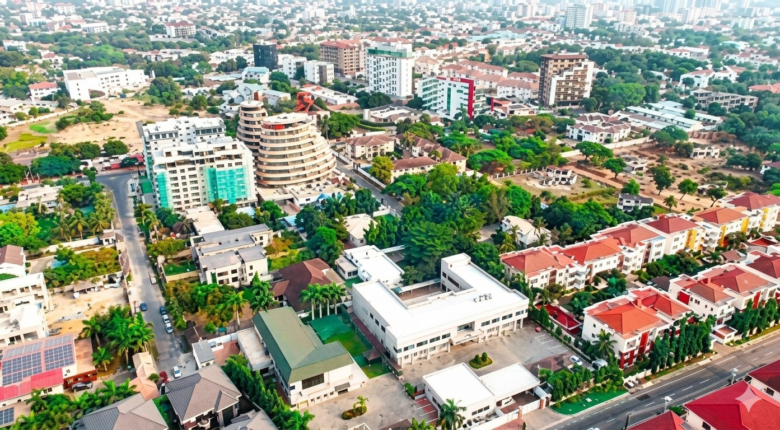
Properties here are ultra-modern villas and custom mansions, many exceeding 5,000 square feet, built on plots of one to two acres. Smart home integrations, en-suite bedrooms, fitted kitchens, home gyms, and private pools are common.
2026 pricing sits between $1.5 million and $5 million for prime four to five-bedroom homes, at roughly $1,400 to $2,500 per square metre. For investors with build capacity, construction costs remain comparatively affordable, which pushes ROI higher on new luxury builds.
Airport Hills vs. Airport Residential: What Is the Difference?
Both neighbourhoods share the same proximity advantage to Kotoka International Airport. The difference is density and exclusivity.
Airport Residential is established and prestigious. Airport Hills takes that foundation and strips away the congestion. Fewer homes. Larger plots. More controlled access. If Airport Residential is business class, Airport Hills is the private terminal.
Your Trusted Realtor’s Take
I have walked clients through this market across four continents. The ones who invest in Airport Hills are not buying a home. They are buying a long-term asset that pays them in hard currency, appreciates in a supply-constrained market, and carries the kind of status that compounds over time.
The families I have placed here tell me the same thing after two or three years: they wish they had moved faster.
Frequently Asked Questions About Airport Hills
What does a typical Airport Hills property cost in 2026?
Prime four to five-bedroom homes range from $1.5 million to $5 million, at $1,400 to $2,500 per square metre depending on build quality and plot size.
Are Airport Hills properties suitable for short-term rentals?
Yes. Business travellers and corporate tenants drive strong demand. Gross yields on premium short-lets reach 8 to 22%.
How does security compare to Cantonments or Ridge?
Airport Hills offers gated community security with biometric staff access and 24/7 private patrols. It surpasses both Cantonments and Ridge in controlled access and low-density zoning.
Is there off-plan stock available?
Limited. Land scarcity means most opportunities are in established estates. Your best path is working with an agent who has direct developer relationships and access to pre-market stock.
Why choose Airport Hills over Airport Residential Area?
Same airport proximity, significantly more privacy. Larger plots, lower density, and a more exclusive community profile with stronger capital preservation characteristics.
Ready to see what Airport Hills looks like in person, or from your living room abroad? Book a consultation with Sarah Arthur, your trusted realtor, and get direct access to verified listings before they hit the open market.